

The Biet - elevation, village signs and history
Schellbronn is at 540 m on the Biet plateau, where forest-row villages emerged from clearings and first appeared in records as Scaltebrunn in 1073. Village signs still show the coats of arms of Hamberg, Neuhausen, Steinegg and Schellbronn, reflecting the history of Hirsau Monastery, the Barons of Gemmingen and the four local districts that became the municipality of Neuhausen.
Schellbronn sits on the "Biet" plateau between Nagold and Wurm valleys, at the forest edge around 540 m. "Biet" is the colloquial name for the former Gemmingen territory: eight forest-row villages on higher ground. Four of those now belong to the municipality of Neuhausen: Hamberg, Neuhausen, Schellbronn and Steinegg.

Among those four districts, Schellbronn is the earliest documented. In 1073, Scaltebrunn appears in a charter of Hirsau Monastery, decades before Neuhausen, Steinegg and Hamberg. The name points to a spring or fountain, still reflected by the symbol on village signs. Like most Biet villages, Schellbronn developed as a forest-clearing settlement.
In 1134, a chapel dedicated to St. Nicholas was consecrated here. From the 12th to the 15th century, the village was largely under Hirsau ownership; a monastic estate in the district is documented no later than 1433. Today's St. Nicholas Church in the center and the Biet chapel trail still point to this early period.
At village entrances, Hamberg, Neuhausen, Schellbronn and Steinegg still carry their own coats of arms, each referring either to the place name or to the colors of the Barons of Gemmingen: red house, fountain, wolf-hooks and ploughshare.
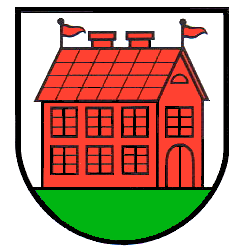


Wappen der Ortsteile · Wikimedia Commons (Public Domain)
From 1407 onward, the Biet was ruled by the Barons of Gemmingen-Hagenschiess. Diether V von Gemmingen acquired Steinegg Castle from the Lords of Stein; his son Diether VI completed the territory across eight districts. From Steinegg, the Gemmingen family ruled until 1806 as a small imperial-knightly domain behind Hagenschiess forest, Catholic in a largely Protestant surrounding region. The forest chapel near the castle and the chapel trail still tell this chapter.
For a long time, the four villages remained independent municipalities. During municipal reform, Hamberg, Neuhausen and Steinegg merged in 1973 to form the municipality of Neuhausen; Schellbronn joined in 1975. Since 1980, the combined municipality has used one shared coat of arms: Neuhausen's red house, now with blue and gold base as a link to Hamberg, Steinegg and former territorial lords.
 Gemeindewappen Neuhausen im Enzkreis · Wikimedia Commons (Pub...
You can still feel the elevation today: clear air, wide views over meadow orchards and Heckengau, morning mist in the pines, and evening stars without city glow. Staying in Ferienpark Schellbronn means sitting in the middle of this landscape, both geographically and in a region with distinct history.